
Case study · Water quality modelling
Water quality modelling of a 128 km transmission main and farm networks, Mirfa–Liwa, Abu Dhabi
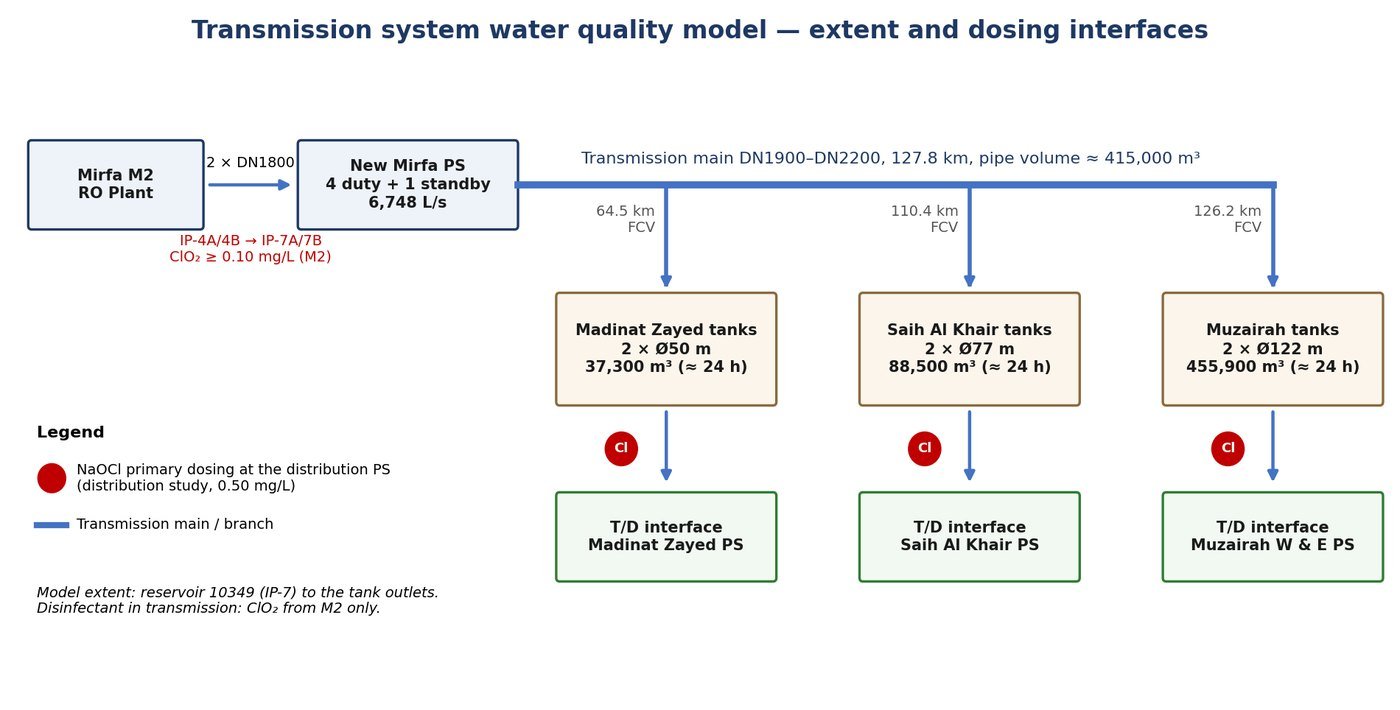
Multi-species and chlorine residual modelling for a 128 MIGD scheme. Desalinated water travels from Mirfa through 128 km of DN1900–DN2200 transmission main to four farm distribution networks serving 8,011 farms in Madinat Zayed, Saih Al Khair and Liwa.
Client
TAQA
Location
Mirfa, Madinat Zayed & Liwa, Abu Dhabi
Scope
Chlorine dioxide and by-products, free chlorine, dosing strategy
Tools
InfoWorks WS Pro (MSX), Bentley WaterGEMS
Criteria
DoE Water Quality Regulation 2025
128 km
DN1900–DN2200 transmission main
8,011
Farm connections assessed individually
99.9%
Compliance at governing low demand, conservative case
15.5 kg/h
Hypochlorination capacity sized (as Cl₂)
The challenge
Long residence times at 45 °C
The transmission main holds around 415,000 m³ and each storage tank holds a day of demand, so water can be in the system for days at low demand. The source water carries chlorine dioxide from the desalination plant and contains bromide, which raises a bromate risk if free chlorine is used too early. The 0.20–0.50 mg/L residual had to be achieved at every one of 8,011 farm connections.
Our approach
Transmission and distribution water quality modelling
- Transmission: multi-species (MSX) model tracking chlorine dioxide, chlorite, chlorate, bromide, free chlorine, hypobromous acid, bromate and water age
- Decay coefficients from bottle tests at the 45 °C design temperature, with an aged-pipe wall decay allowance
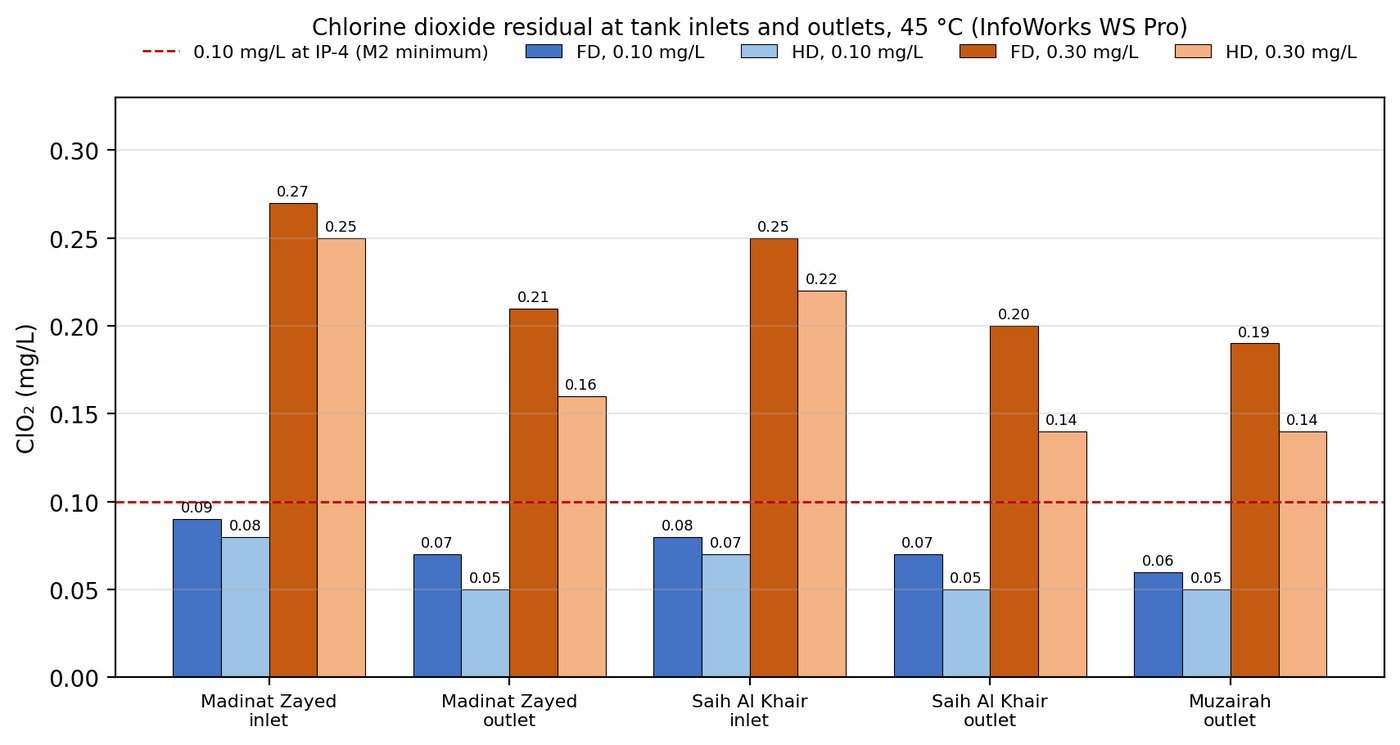
- Four cases: full and half demand, each with 0.10 and 0.30 mg/L chlorine dioxide at the source
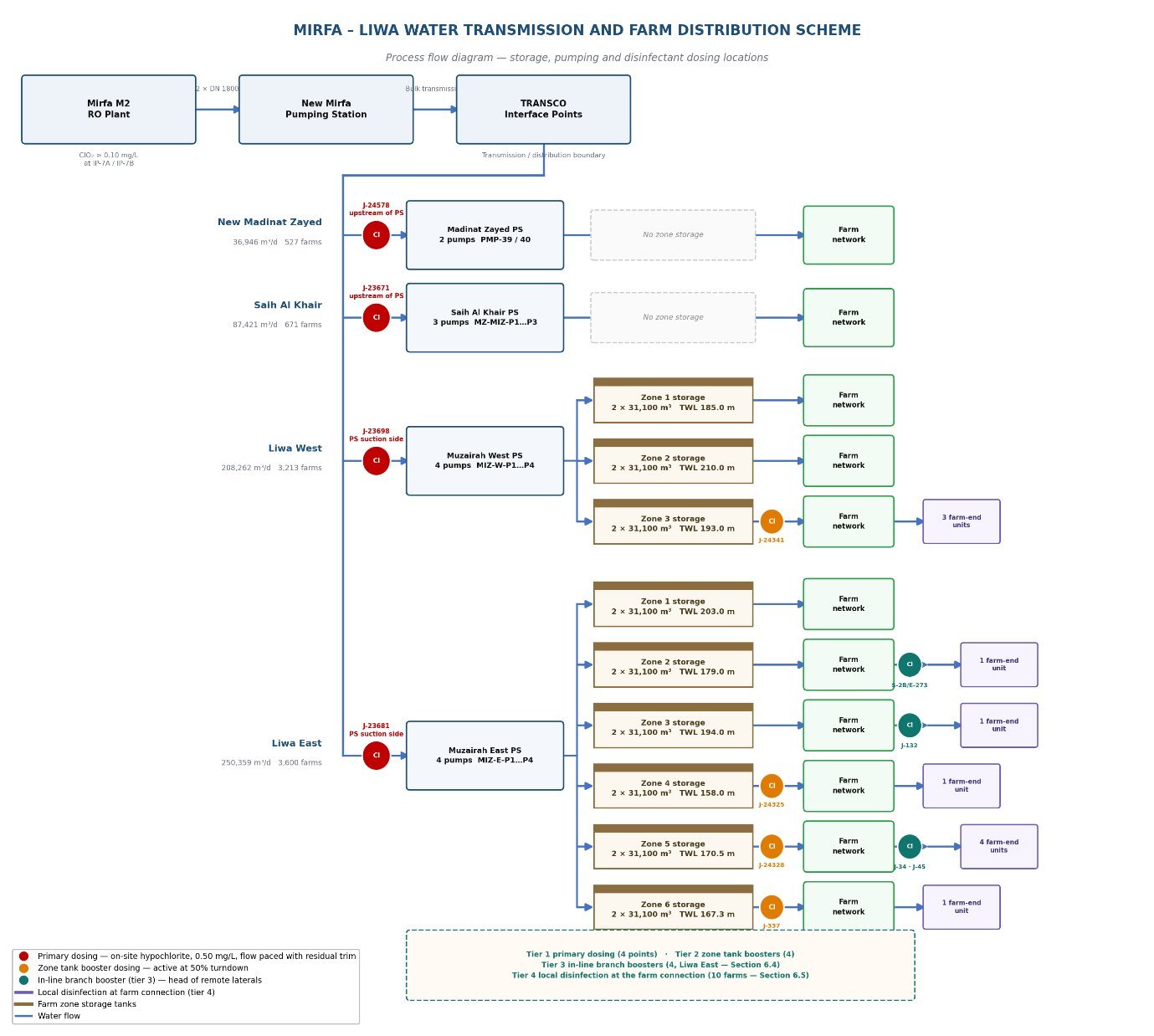
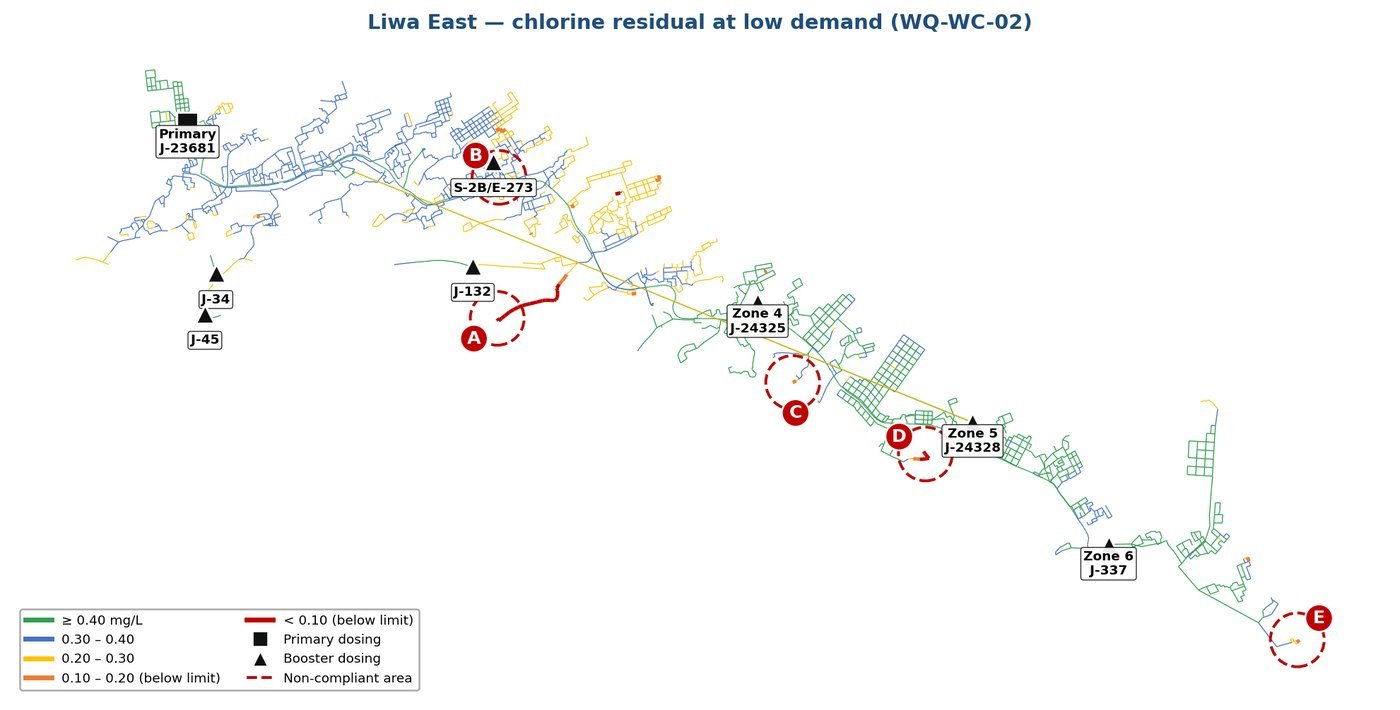
- Distribution: free chlorine residual computed at all 8,011 farm connections at full and 50% demand, with no credit taken for incoming residual
- Dosing strategy developed: primary dosing at the four distribution pumping stations, zone boosters at tank outlets and in-line branch boosters
- Hypochlorination capacity sized at each dosing point
Results
Key results
Key findings
- A positive chlorine dioxide residual is maintained through the whole transmission system in all cases.
- Chlorite and chlorate stay well below the 0.7 mg/L screening value, and no bromate forms because no free chlorine is present in transmission.
- No new disinfection facility is needed in the transmission system. Hypochlorite is dosed downstream of the storage tanks instead.
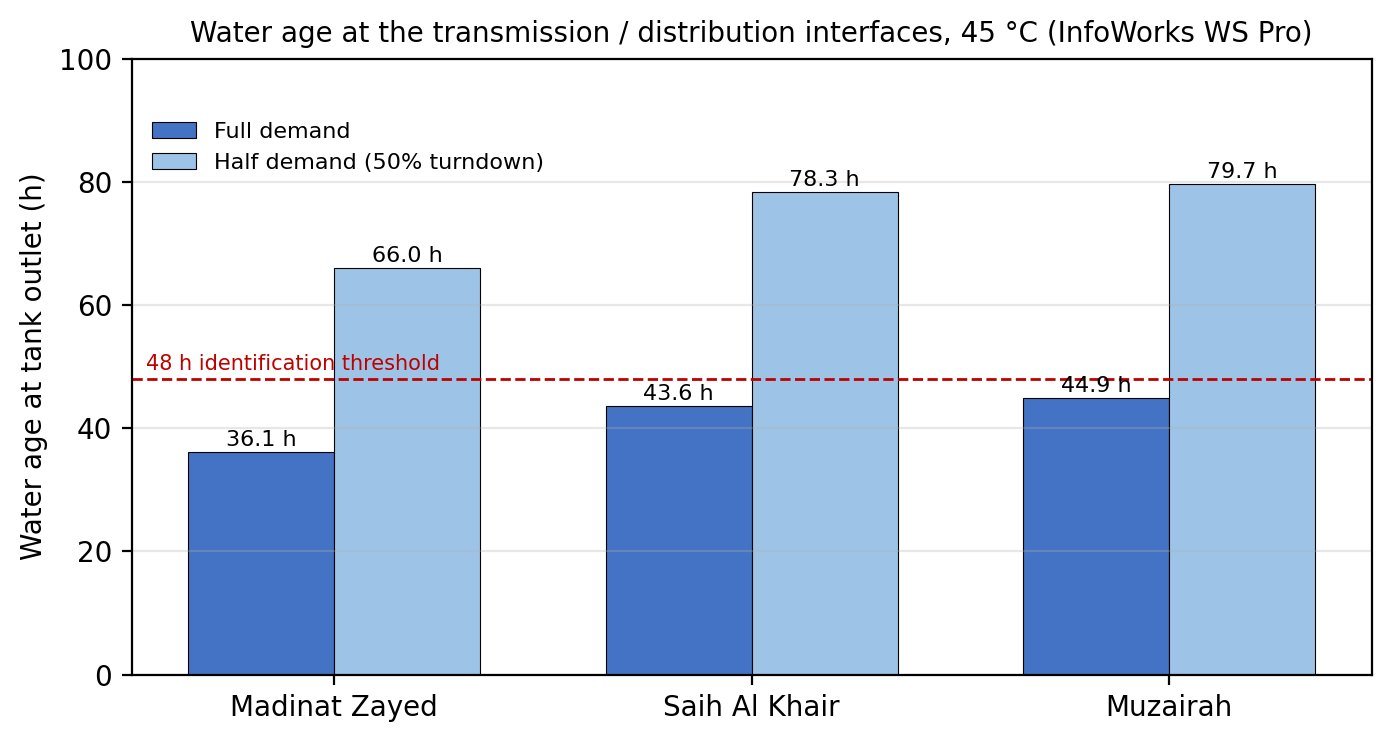
- Storage drives water age: up to 45 h at full demand and 80 h at half demand.
- In the distribution networks, 99.9% of connections comply at the governing low-demand case under a conservative aged-pipe assumption, and 100% on a new-pipe basis.
- The few remaining connections, about 0.04% of demand, are addressed by local disinfection. Recalibration after commissioning is recommended.
Working on a similar project?
Share your network layout, demands or water quality criteria and we will advise on the right modelling scope.