
Case study · Water network hydraulics & water quality
Farm water supply network: hydraulic & water quality study, Al Bahiya & Al Rahba, Abu Dhabi
Steady-state and water quality modelling of a DN400 ductile iron potable water network supplying farms in Al Bahiya and Al Rahba. The study was updated for a variation that added 30 new farms through a new supply metering point.
Client
TAQA Distribution
Location
Al Bahiya & Al Rahba, Abu Dhabi
Scope
Steady-state hydraulics, valve settings, chlorine residual and water age
Tools
InfoWorks WS Pro (steady state + 48 h EPS)
Criteria
≥ 1.25 barg at farms · ≥ 0.2 mg/L free chlorine
2.40 / 2.88 MIGD
Average / peak day demand
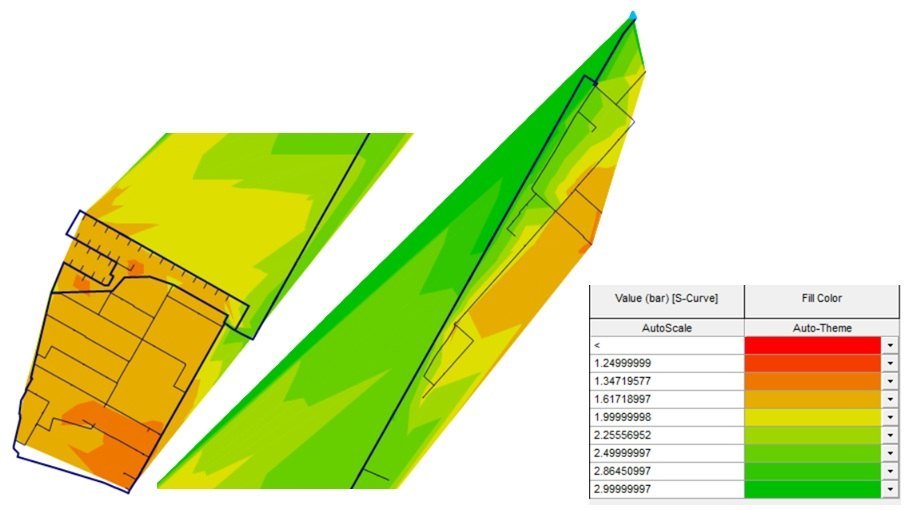
≥ 1.36 barg
Lowest farm pressure at average day demand
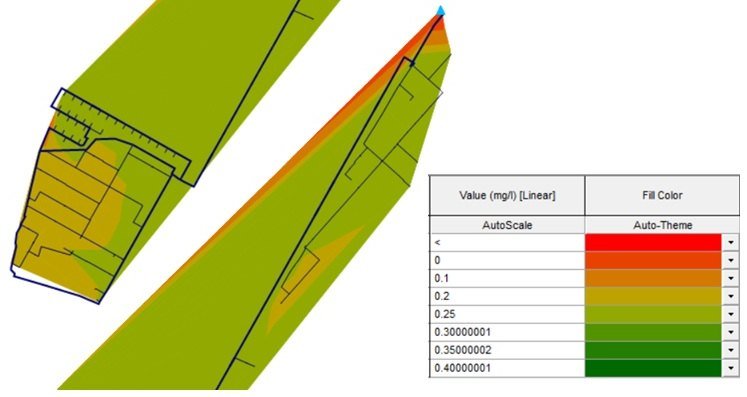
0.21–0.34 mg/L
Minimum chlorine residual across scenarios
≤ 18 h
Maximum water age in the network
The challenge
More farms on an existing trunk main
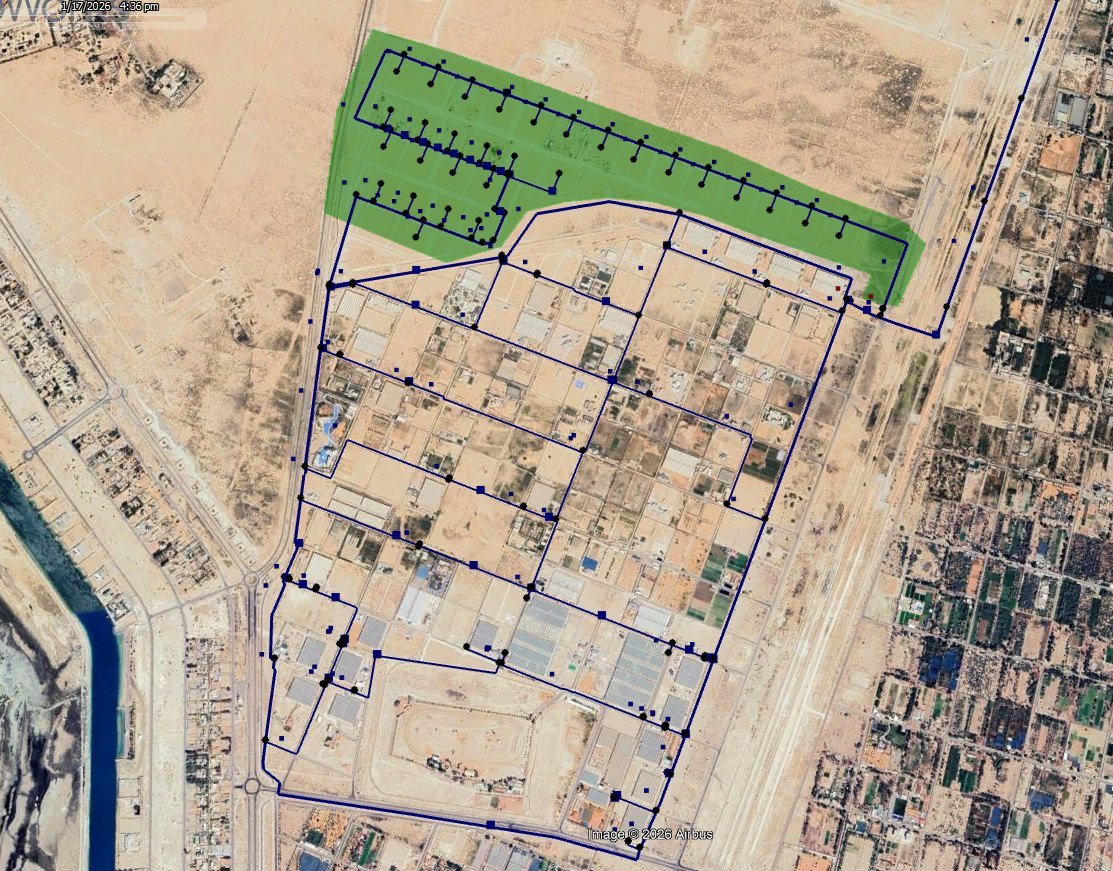
The network takes water from a DN1200 transmission main through an interface control valve and a DN400 ductile iron trunk main. Adding 30 farms through a new supply metering point increased demand and changed flow paths. Pressures had to stay at or above 1.25 barg, and free chlorine at or above 0.2 mg/L, at every farm connection, including the most remote ones on undulating ground.
Our approach
Hydraulic and water quality modelling
- Network built from surveyed topography and detailed routing: DN400 ductile iron trunk main, HDPE distribution mains and farm service connections
- Average day, peak day and minimum demand scenarios run at the agreed interface valve set pressures
- Interface valve, supply metering point flow control valves and a DN300 axial tap-off valve modelled to check throttling ranges
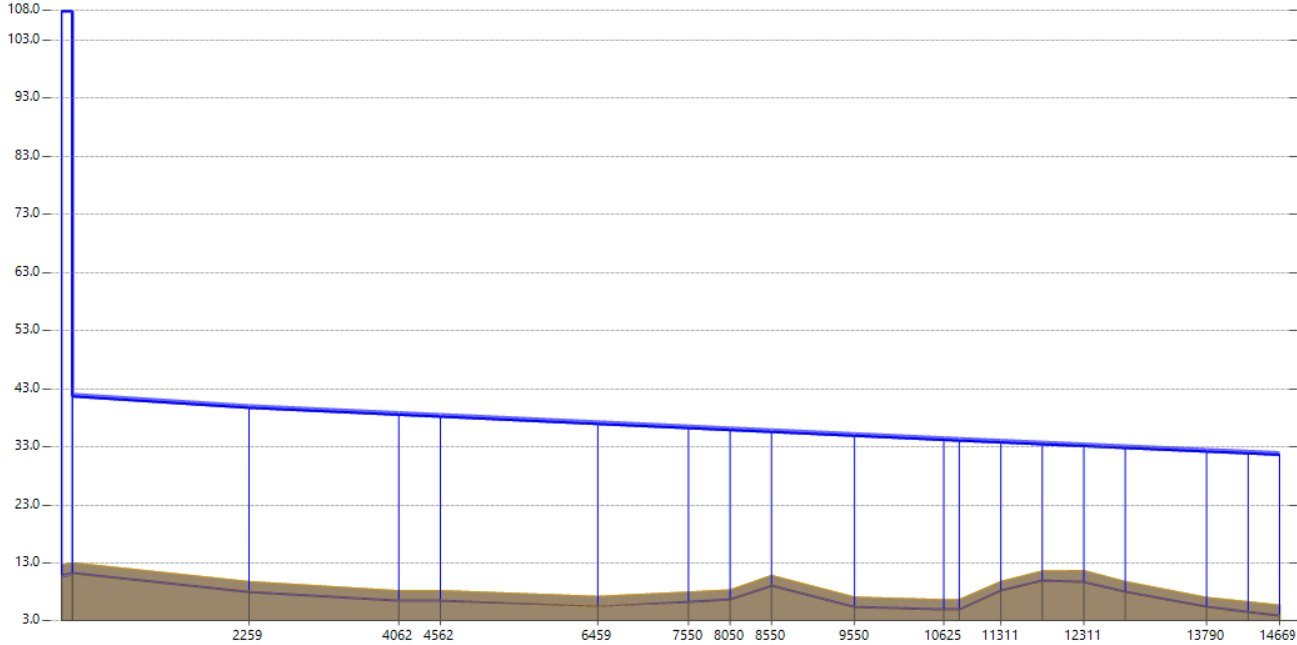
- Hydraulic grade line profiles along the trunk main to locate pressure limits
- 48-hour extended-period simulation of free chlorine with first-order bulk and wall decay (bulk −0.04 to −0.22 day⁻¹) and dosing of 0.3–0.4 mg/L downstream of the inlet control valve
- Water age mapped across the network to identify remote, slow-moving zones
Results
Key results
Key findings
- All farms meet the 1.25 barg minimum at average and minimum demand; the lowest is 1.36 barg.
- At peak day demand, 15 farms in New Al Bahiya fall slightly short (minimum 1.12 barg). Raising the interface set pressure to about 4.6 barg and upsizing two service connections to OD160 restores compliance.
- Velocities stay within limits: up to 1.11 m/s in the trunk main and 1.54 m/s in service connections. Periodic flushing is recommended for low-velocity mains.
- Minimum tie-in pressures defined for each demand case, for agreement with the utility.
- Minimum free chlorine of 0.21–0.34 mg/L at all farm connections, above the 0.2 mg/L requirement.
- The lowest chlorine does not occur at the point of oldest water. Dosing capacity of up to 0.5 mg/L is recommended to allow for future demand and ageing pipes.
Surge analysis
Transient (surge) analysis
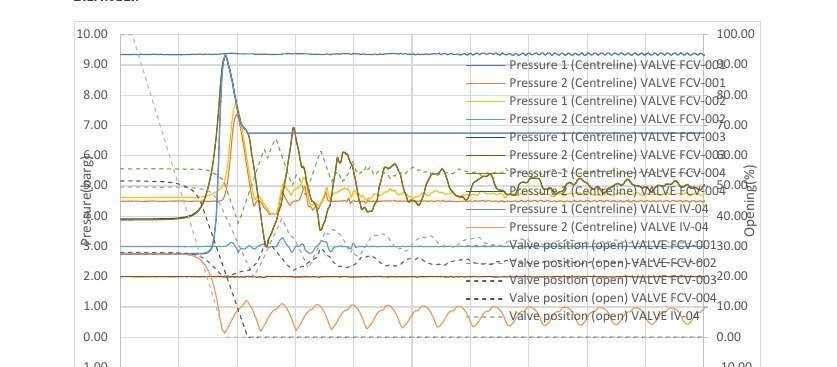
The same network was also analysed for transients in WANDA. The cases covered an upstream pump trip, valve closure in the DN1200 transmission main, inadvertent closure and opening of the interface control valve, PRV and isolation valve closures, and controlled pipeline filling.
- The network stays hydraulically stable in all transient cases once the valve operating philosophy and automatic protection logic are applied.
- Valve stroke time is the governing parameter: a 120 s full closure for the interface control valve and 90 s for the PRVs keep transient pressures within the pipe ratings.
Working on a similar project?
Share your network layout, demands or water quality criteria and we will advise on the right modelling scope.