
Services · AI & digital twins · UAE & GCC
AI water network optimisation & digital twins
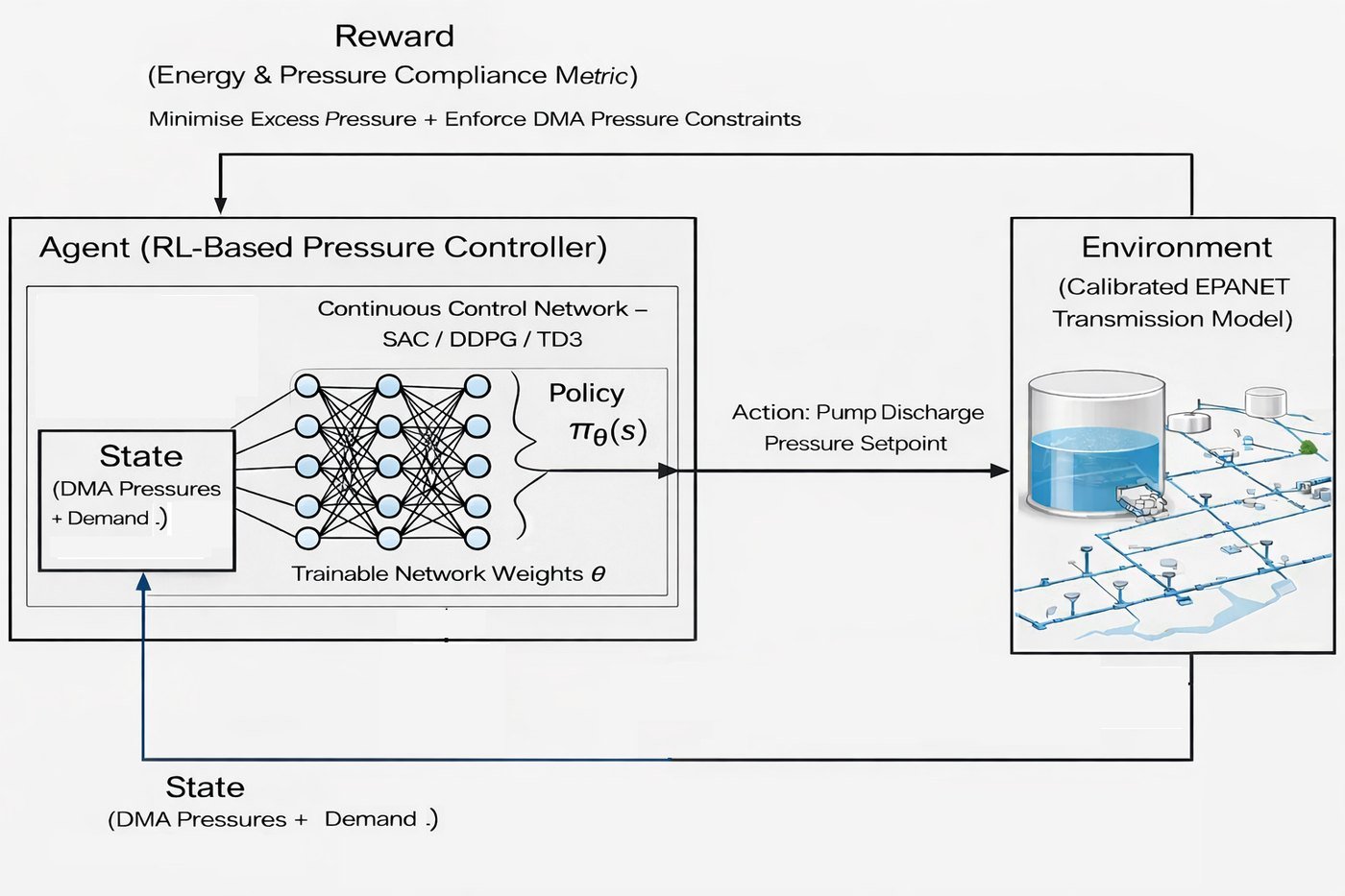
We build digital twins of water networks from calibrated hydraulic models and SCADA data, then train AI controllers that set pump and valve pressures in real time, reducing excess pressure, energy and leakage while keeping every customer in service. We deliver across the UAE, the wider GCC and internationally.
Digital twins
Calibrated EPANET models linked to SCADA data
AI pressure control
Deep reinforcement learning for pump set points
Peer-reviewed research
Published in ASCE Journal of Water Resources Planning & Management
Why it matters
Why AI water network optimisation matters
Most networks are still run on fixed pressures set for peak demand. In off-peak hours that means excess pressure, wasted pumping energy, more leakage and more stress on pipes. Utilities already collect the demand and pressure data needed to do better: it is rarely used to drive operation.
An AI controller trained on a digital twin turns that data into optimal set points, every 15 minutes, not just once in a design report.
AI water network optimisation allows you to:
- Run pumping stations at the lowest pressure that still meets minimum service levels
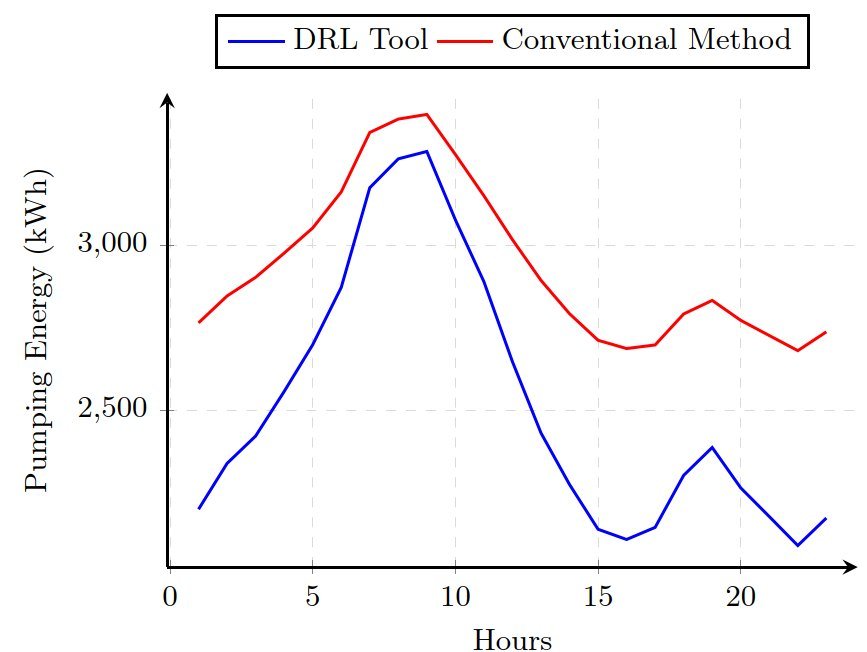
- Cut pumping energy, with about 14% estimated in our peer-reviewed case study
- Reduce leakage, non-revenue water and pipe stress by trimming excess pressure
- Coordinate several interconnected pumping stations instead of tuning each alone
- Test control strategies safely on the digital twin before using them in the field
Scope of services
What an AI optimisation project includes
01
Digital twin build
- Calibration of the hydraulic model to SCADA data
- EPANET / EPyT Python integration
- Demand patterns and scenario generation
- Validation against measured pressures and flows
02
AI controller development
- Reinforcement learning environment design
- Continuous-control agents (SAC, TD3, DDPG)
- Reward design for pressure, energy and constraints
- Training, testing and benchmarking against current operation
03
Pilot & deployment
- Savings assessment on historical data
- Supervisory control loop design
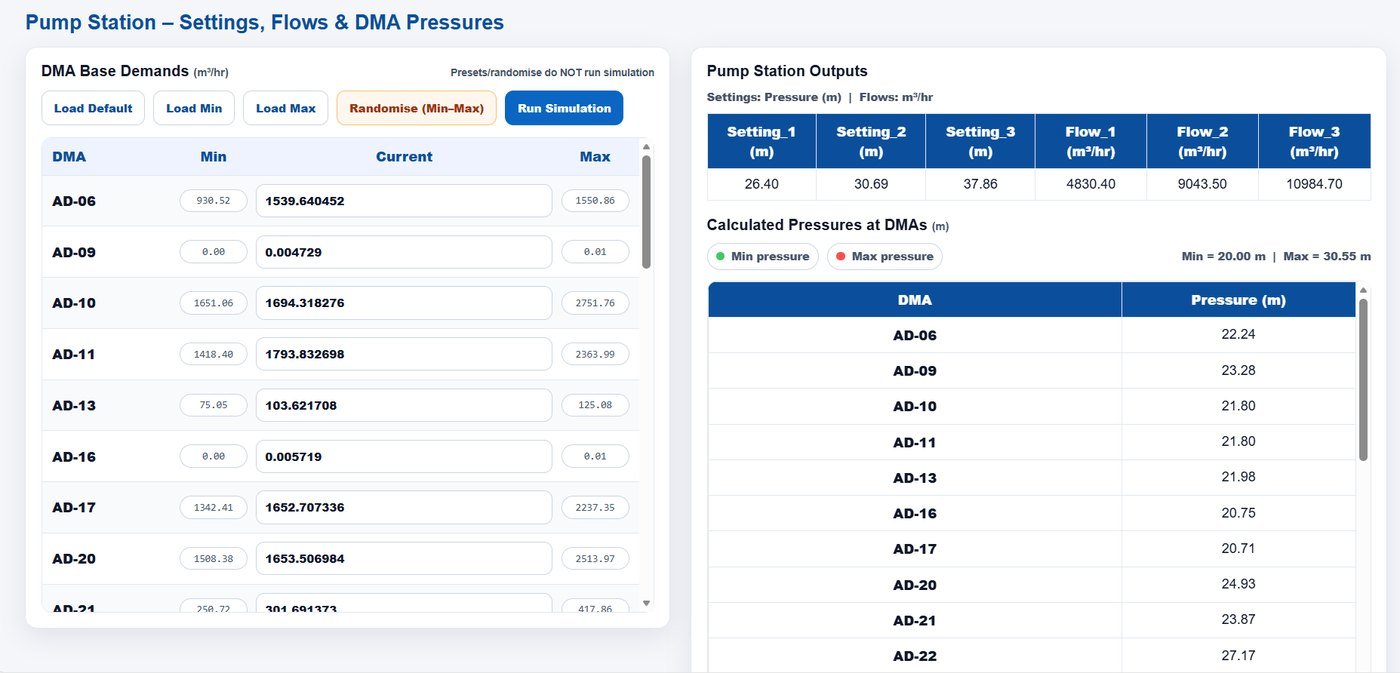
- Web-based decision support tool
- Operator training and monitoring
Research & projects
AI optimisation projects
-
Deep reinforcement learning for pump pressure optimisation in a regional transmission network
A continuous-control DRL agent trained on an EPANET digital twin sets pressures at three pumping stations, keeping all 35 DMAs in service with an estimated 14% energy saving.
Process
How we work with you
STEP 01
Data & feasibility
We review your hydraulic model, SCADA history and pumping arrangement, and estimate the savings potential on historical demand.
STEP 02
Digital twin & training
We calibrate the digital twin, design the control problem and train and benchmark AI controllers against your current operation.
STEP 03
Pilot & handover
We run a supervised pilot, deliver a decision-support tool and train your operators, with clear rules for when the controller is used.
Outputs
Typical deliverables
Each project is scoped from a feasibility study to a live pilot. Typical outputs include:
- Feasibility report with the estimated energy and pressure savings
- Calibrated digital twin with Python integration
- Trained AI controller with benchmark results
- Decision-support web tool for operators
- Pilot report and recommendations for full deployment
Tools & methods
Tools and methods
We combine established hydraulic modelling with modern open-source machine learning, so models stay transparent and auditable.
| Hydraulics | EPA EPANET, EPyT (Python), InfoWorks WS Pro |
| Machine learning | Stable-Baselines3: SAC, TD3, DDPG; custom Gym environments |
| Data | SCADA demand, pressure and flow at 15-minute intervals |
| Safety | Hard penalties on minimum-pressure breaches; supervisory deployment |
| Related studies | Water network modelling and surge analysis |

FAQ
AI water network optimisation FAQs
What is a digital twin of a water network?
A digital twin is a calibrated hydraulic model kept in step with the real network using SCADA data. It lets you test control decisions virtually before applying them in the field.
How much energy can AI optimisation save?
It depends on the network and how it is run today. In our case study on a regional transmission network with three pumping stations, the AI controller saved an estimated 14% of pumping energy over a historical daily demand pattern, while keeping all DMAs above minimum pressure.
Is it safe to let AI control pumps?
We deploy in a supervisory mode first: the controller proposes set points and operators or the control system apply them within fixed limits. Minimum-pressure constraints are built into training as hard penalties.
What data do we need to start?
A calibrated (or calibratable) hydraulic model and historical SCADA data on demands, pressures and pump operation, ideally at 15-minute intervals over at least a year.