
Case study · Water quality modelling
Water age & chlorine residual study: tanks, pumping station and transmission lines, Al Bedai
Water quality modelling of a tank and pumping station feeding two transmission mains. The study found a low-demand compliance gap at the furthest reservoir and identified a simple operational fix.
Client
Sharjah Electricity, Water & Gas Authority (SEWA)
Location
Al Bedai, UAE
Scope
Water age, chlorine decay, dosing verification
Tools
Bentley WaterGEMS
Criteria
≥ 0.2 mg/L residual chlorine at delivery points
0.5 mg/L
Design hypochlorite dosing set point per line
8.4 h
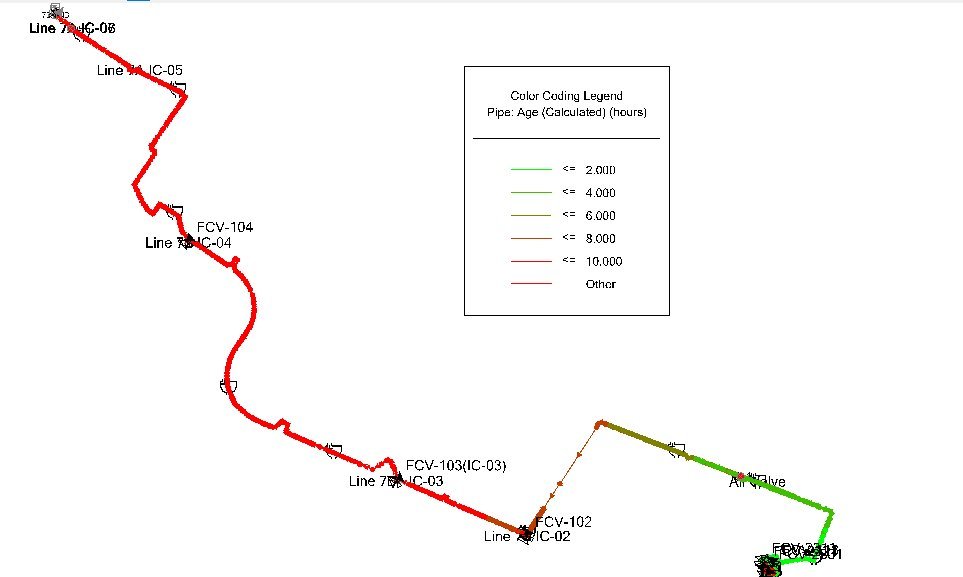
Maximum water age at high demand
96 → 36 h
Water age at the governing reservoir after mitigation
0.07 → 0.21 mg/L
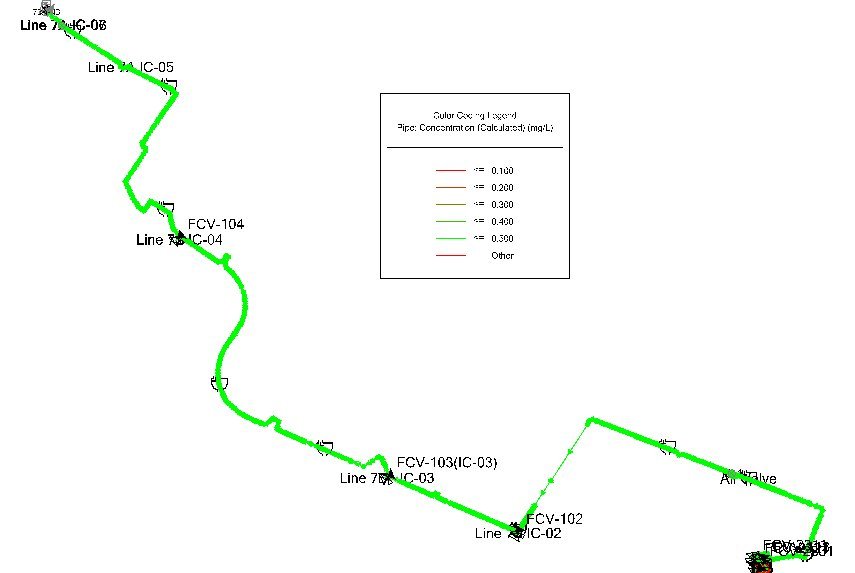
Chlorine residual restored above the minimum
The challenge
Low demand, long mains
Two pump groups feed transmission Lines 7A and 7B, which supply interconnections and a remote reservoir. At low demand, water slows in the long mains, so chlorine decays before it reaches the far end. The study had to confirm that residual chlorine stays at or above 0.2 mg/L at every delivery point.
Our approach
Water quality modelling
- Hydraulic conditions taken from the approved steady-state model of the station and both mains
- Incoming water conservatively assumed to carry no chlorine residual
- Sodium hypochlorite dosing at 0.5 mg/L applied separately to Lines 7A and 7B
- High-demand and low-demand / high-decay scenarios simulated as extended-period runs
- Governing locations for maximum water age and minimum residual identified
- Mitigation options tested for the non-compliant case
Results
Key results
Key findings
- High demand: maximum water age is about 8.4 h, and residual chlorine stays above the criterion throughout.
- Low demand: the remote reservoir inlet governs. Water age reaches about 96 h and residual drops to 0.07 mg/L, below the minimum.
- Mitigation: keeping a minimum flow of about 2 MIGD to that reservoir cuts water age to about 36 h and lifts residual to 0.21 mg/L, which is compliant.
- Dosing can be optimised in operation against measured residuals, provided 0.2 mg/L is maintained.
Working on a similar project?
Share your network layout, demands or water quality criteria and we will advise on the right modelling scope.