
Case study · AI & digital twin
Deep reinforcement learning for pump pressure optimisation in a regional transmission network
A continuous-control deep reinforcement learning (DRL) agent, trained on a calibrated EPANET digital twin, sets the discharge pressures of three interconnected pumping stations in real time. It keeps every DMA above minimum pressure while cutting excess pressure and pumping energy. The research has been published in the ASCE Journal of Water Resources Planning and Management.
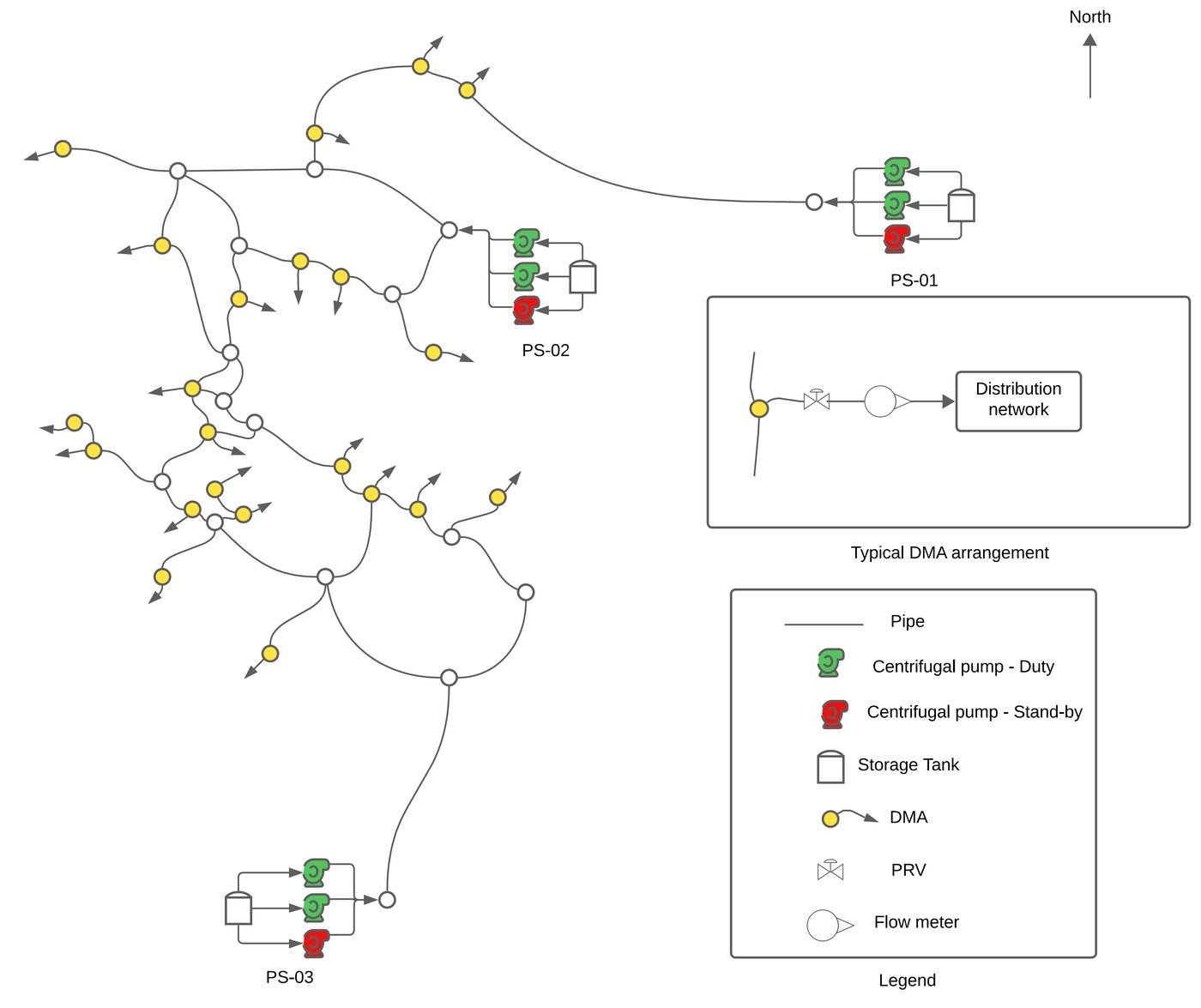
Network
Regional transmission network, UAE
Scope
Real-time pump pressure set points
Tools
EPANET + EPyT, OpenAI Gym, Stable-Baselines3
Publication
ASCE JWRPM (2026)
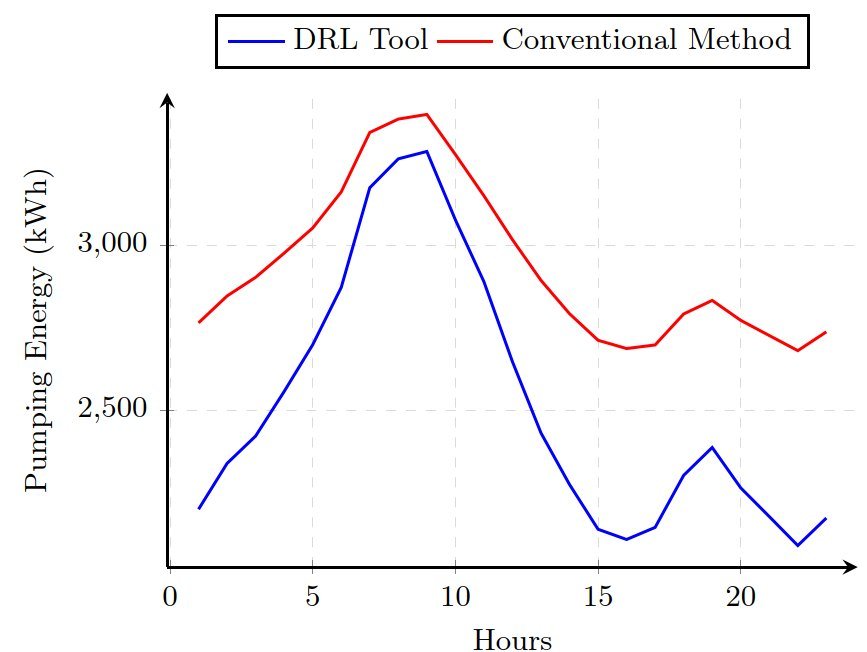
≈ 14%
Estimated pumping energy saving over a historical diurnal pattern
197 km
DN600–1600 ductile iron mains, about 972 km² served
3 stations
10,000–15,000 m³/h each, variable-speed pumps
35 DMAs
Each with a PRV and flow meter, 15-minute SCADA data
The challenge
Fixed pressures waste energy
Demand changes through the day, but pumping stations are often run at pressures set for the peak. At night and in low-demand hours this over-pressurises the network, wastes energy and increases leakage and pipe stress. With three interconnected stations, finding the lowest pressures that still keep every DMA in service is a continuous, nonlinear control problem.
Our approach
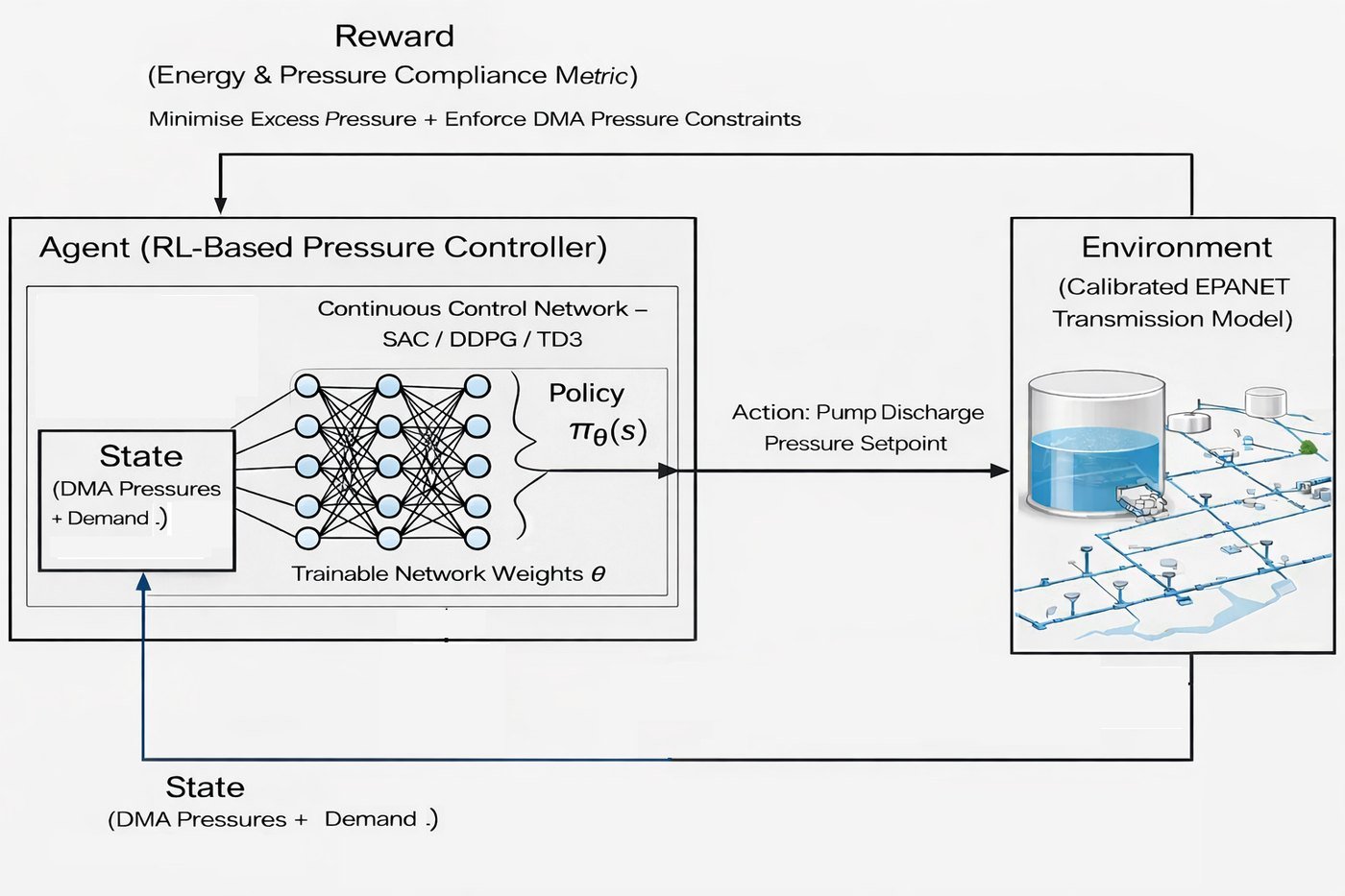
Digital twin and DRL agent
- Calibrated EPANET model of the transmission network used as the digital twin, linked to Python through EPyT
- Custom OpenAI Gym environment wrapping the hydraulic model
- Continuous action space: the agent sets the pressure change at all three pumping stations, matching real variable-speed operation
- 46-dimensional state covering the 35 DMA demands, current and previous set points, and pressure deviation metrics
- Reward that favours lower maximum pressure and on-target pressures, and heavily penalises any breach of minimum pressure
- SAC, TD3 and DDPG agents trained with Stable-Baselines3, then evaluated on historical demand patterns
Results
Key results
Key findings
- The DRL agent learns a stable policy: the training reward rises and levels off as it masters the pressure trade-off.
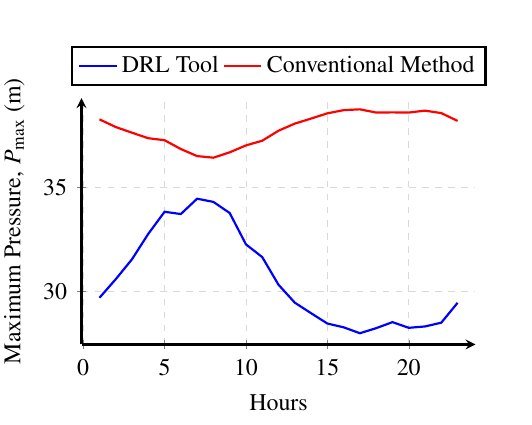
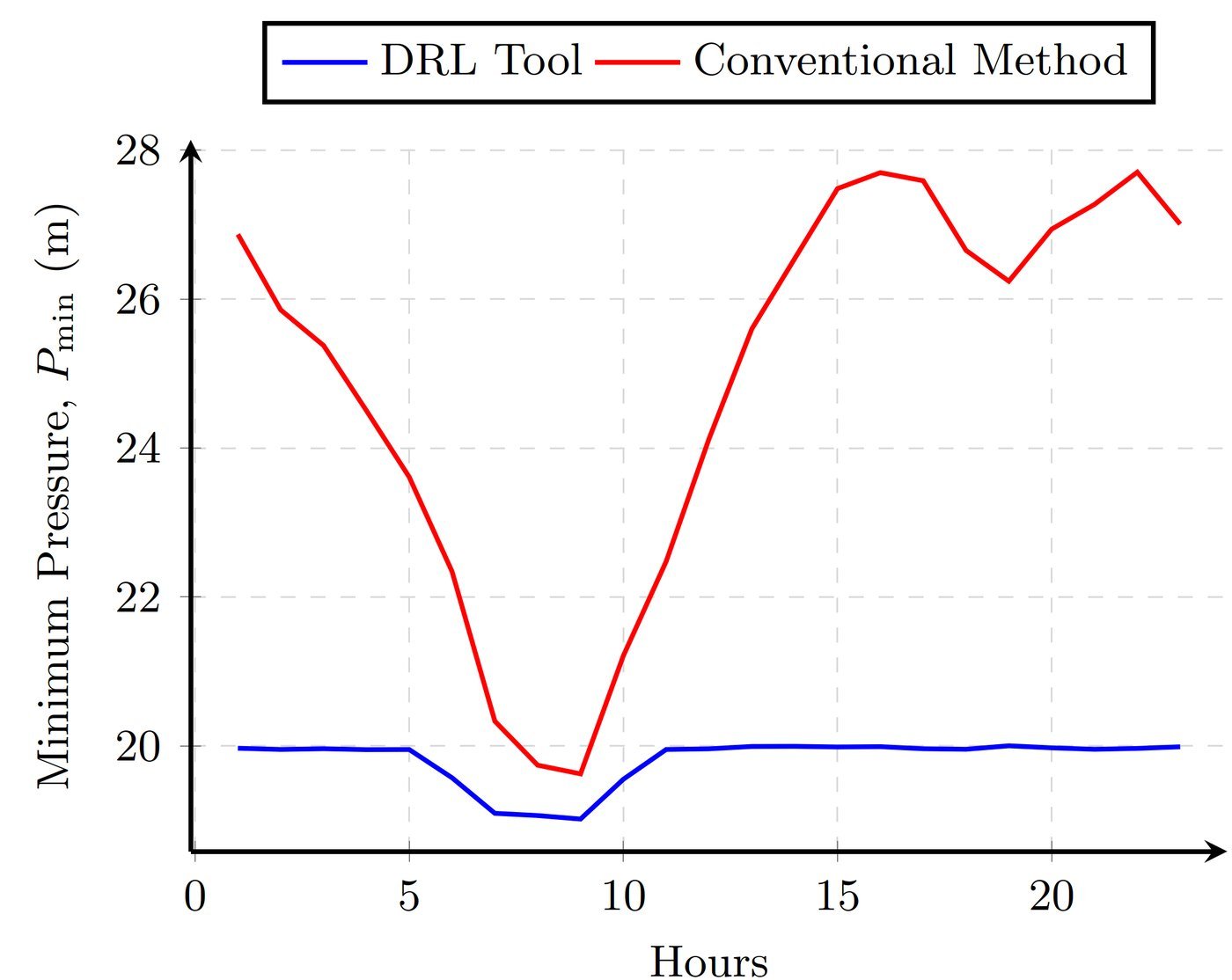
- Over a historical diurnal pattern, the agent holds minimum network pressure at the service level, while conventional operation keeps it much higher in off-peak hours.
- Maximum pressure across the network falls throughout the day, reducing leakage and pipe stress.
- Pumping energy falls by an estimated 14% compared with conventional operation.
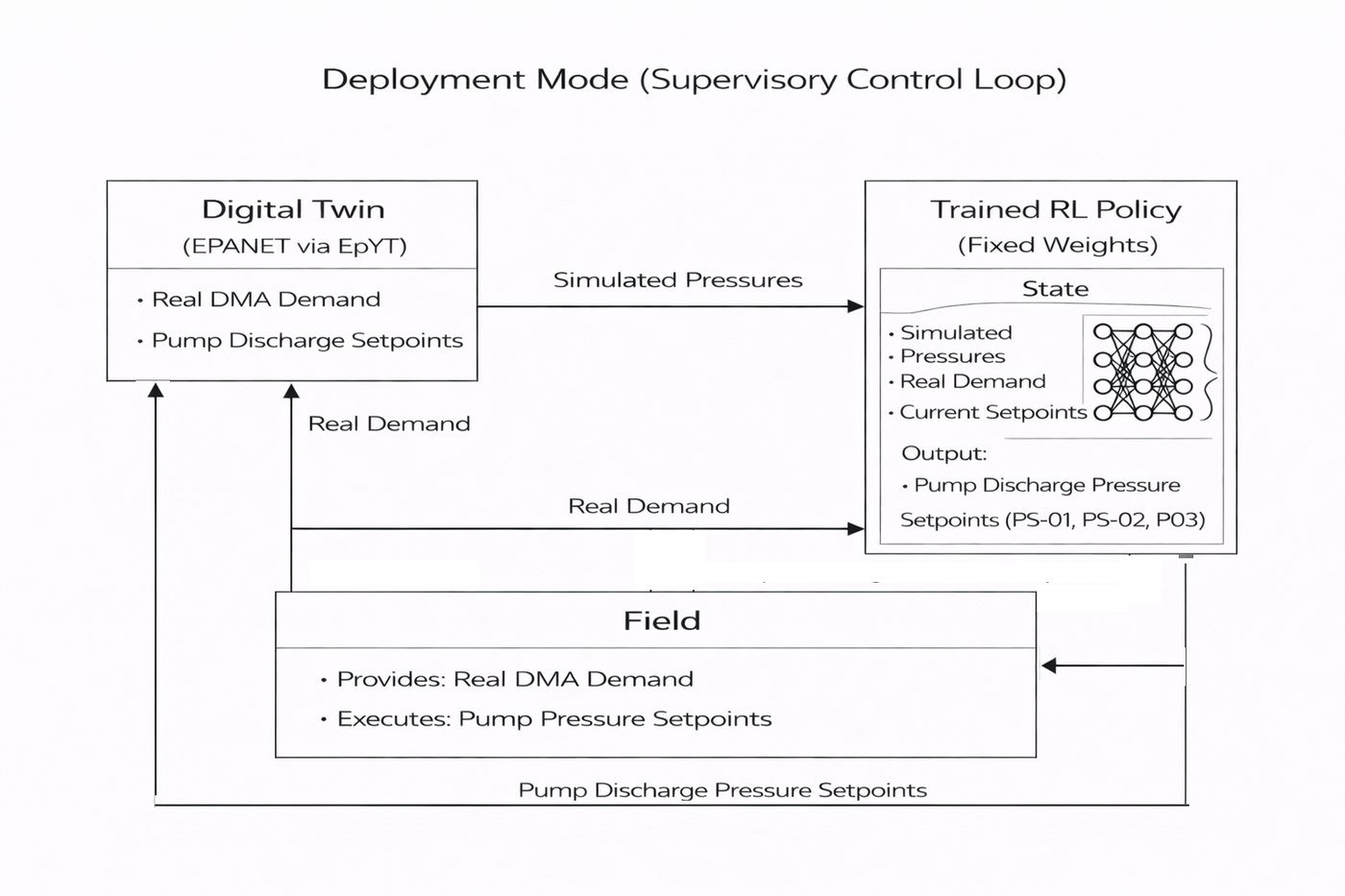
- A web-based tool and a supervisory digital-twin loop were developed so the trained policy can propose live set points from real DMA demands.
Deployment
From research to operation
In deployment, the trained policy runs in a supervisory loop. Real DMA demands feed the digital twin, the agent proposes pump discharge set points, and operators or the control system apply them in the field. The work is continuing towards multi-objective control of pressure and water quality, transfer between network topologies, and safe online learning.
Interested in a pilot for your network?
If you have a calibrated model and SCADA history, we can assess the savings potential and scope a digital twin pilot.