
Case study · Stormwater pump station
Stormwater pump station & force main design: Qasr Rawdat Al-Reef, Abu Dhabi
Steady-state hydraulic design of a stormwater pump station and HDPE force main that drains surface water from the Qasr Rawdat Al-Reef area to the nearest stormwater network. It covers life-cycle-cost pipe sizing, pump duty selection and checks on parallel pump operation.
Client
Department of Municipalities & Transport (DMT)
Location
Qasr Rawdat Al-Reef, Abu Dhabi
Scope
Pipe sizing, pump selection, parallel operation, HGL
Tools
Hydraulic calculations, verified in WANDA
Criteria
Pumps within preferred operating region
90 L/s
Maximum design flow (normal 60 L/s)
OD315 HDPE
Force main chosen on lowest life-cycle cost
3 × 30 L/s
Submersible pumps at about 34 m head
WANDA
Independent check of the hand calculations
The challenge
Lifting surface water to an existing network
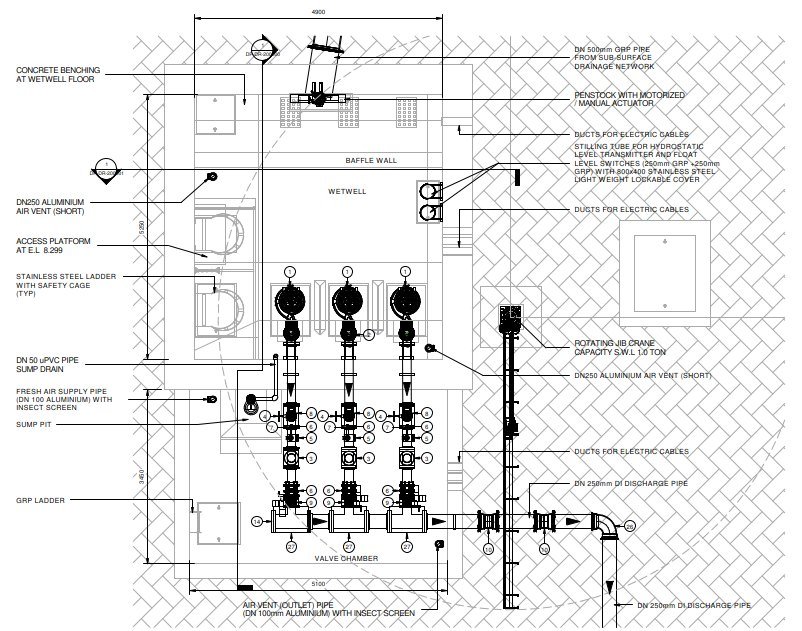
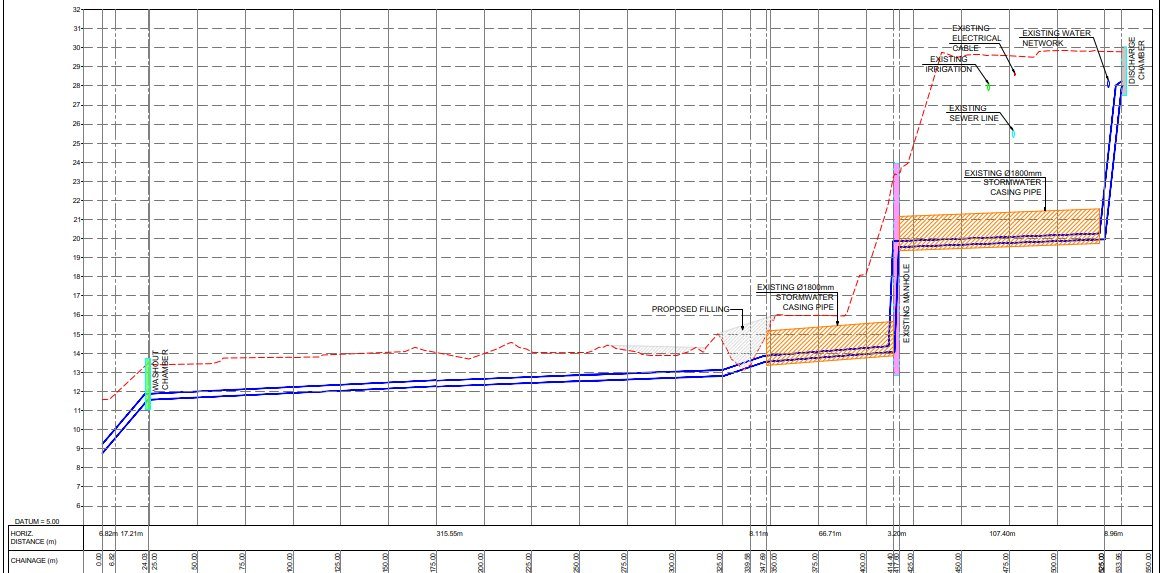
Surface water collected by perforated pipes must be lifted from a wet well and pumped through a force main that rises over existing utilities and casings to reach the stormwater network. The pumps had to stay in their preferred operating region across all wet well levels and pipe roughness conditions, from 30 L/s up to the 90 L/s design flow.
Our approach
Design methodology
- Pipe size chosen by life-cycle cost: capital cost of each HDPE size against pumping energy over the design life. OD315 SDR11 gave the lowest total.
- System curves built for minimum and maximum wet well levels and for low and high pipe roughness
- Pump duty set so three pumps deliver 90 L/s at low water level with high roughness, at 30 L/s and about 34 m each
- One, two and three pumps in parallel checked against each system curve
- Velocity, pressure and HGL checked along the force main, with pipe ratings derated for 45 °C
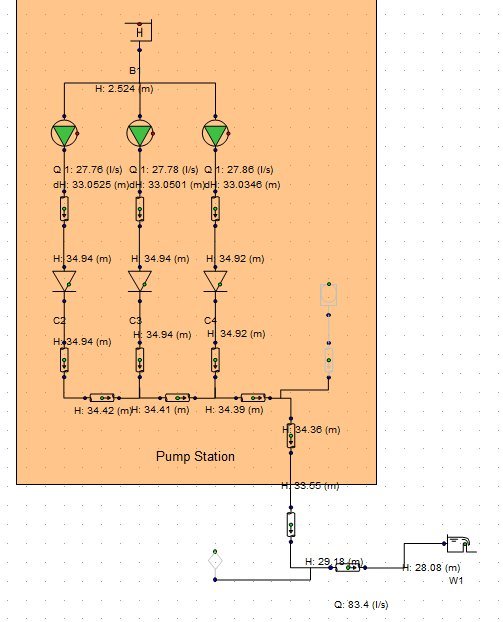
- One case recalculated in WANDA to verify the results
Results
Key results
Key findings
- OD315 SDR11 HDPE gives the lowest life-cycle cost for the force main.
- Two or three pumps in parallel operate within the preferred region and deliver the design flows.
- Running one pump alone is not recommended: it would run beyond its maximum flow, so the control philosophy should avoid it.
- Velocities, pressures and the HGL are within allowable limits in every case.
- The WANDA check matches the hand calculations, confirming the design.
Surge analysis
Transient (surge) analysis and surge vessel sizing
A pump trip at maximum flow with smooth pipes caused unacceptably low pressures and cavitation. A vacuum break valve alone gave no real improvement, so a surge vessel was sized by a parameter study of volume and pre-charge in WANDA.
- A 1.73 m³ bladder surge vessel (1,000 mm diameter × 2,200 mm high) with a 0.4 barg pre-charge meets all criteria across wet well levels and pipe roughness cases.
- The vessel connection should move downstream of the DN250 gate valve, to avoid surges when the valve is closed against running pumps.
- A trip of the running pump followed by a standby pump start gives no unacceptable pressures.
- The vessel must stay online at all times. A standby vessel is recommended.
Working on a similar project?
Share your pump station brief, levels or force main route and we will advise on the right modelling scope.