
Case study · CFD of pumping stations
CFD study of a pump suction manifold: Al Bedai tanks & pumping station
ANSYS Fluent study of the common suction manifold that feeds two pump groups from four storage tanks. It establishes how evenly the flow divides between the pump suction branches, a question one-dimensional network models cannot answer.
Client
Sharjah Electricity, Water & Gas Authority (SEWA)
Location
Al Bedai, UAE
Scope
Flow split between pump suction branches
Tools
ANSYS Fluent, steady-state RANS
Criteria
±10% flow distribution · suction velocity limits
1,579 kg/s
Total flow with six duty pumps
16.53–16.80%
Share per branch, against 16.67% for an even split
< 1%
Maximum departure from the mean
3 meshes
302k to 722k cells, under 0.08 points change
The challenge
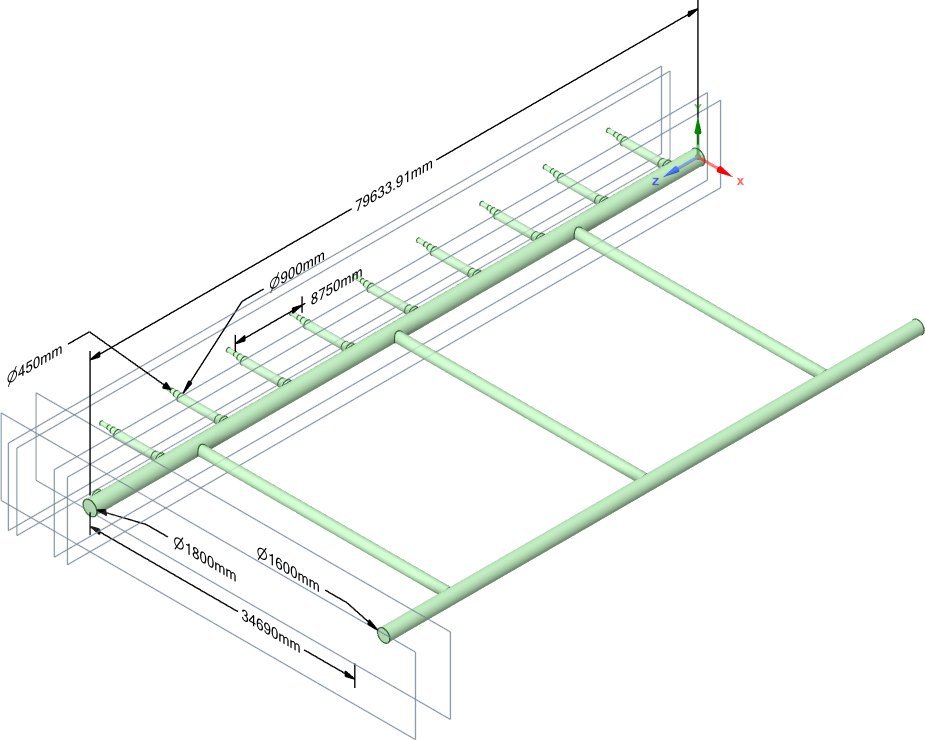
Closely spaced branches on a large header
The pump branches come off a large-diameter header at close spacing, and the header is fed from both ends. Losses at each take-off depend on local flow separation, so a 1D network model cannot predict how evenly the flow divides. An uneven split would push some pumps away from their best efficiency point.
Our approach
CFD methodology
- 3D model of the manifold built from the issued piping arrangement
- Steady-state simulation for six duty pumps, and for five duty pumps with one branch closed
- Mass flow computed at each suction branch and compared with a uniform split
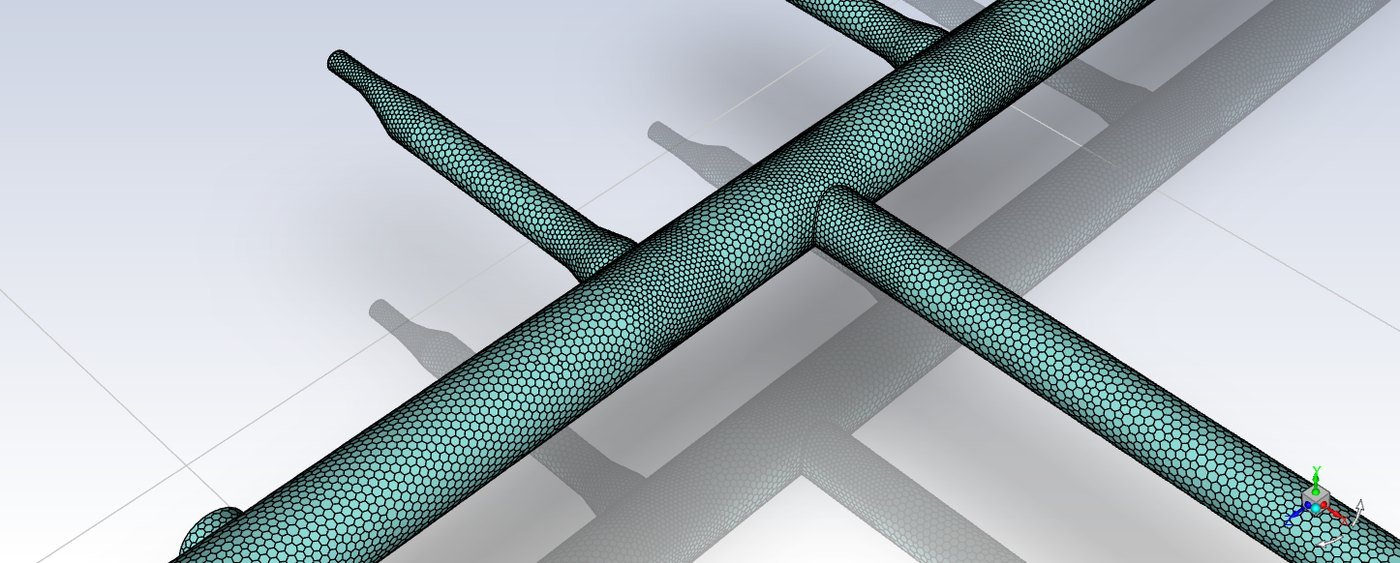
- Mesh sensitivity on three meshes from about 302,000 to 722,000 cells
- Branch velocities checked against customary suction piping limits
Results
Key results
Key findings
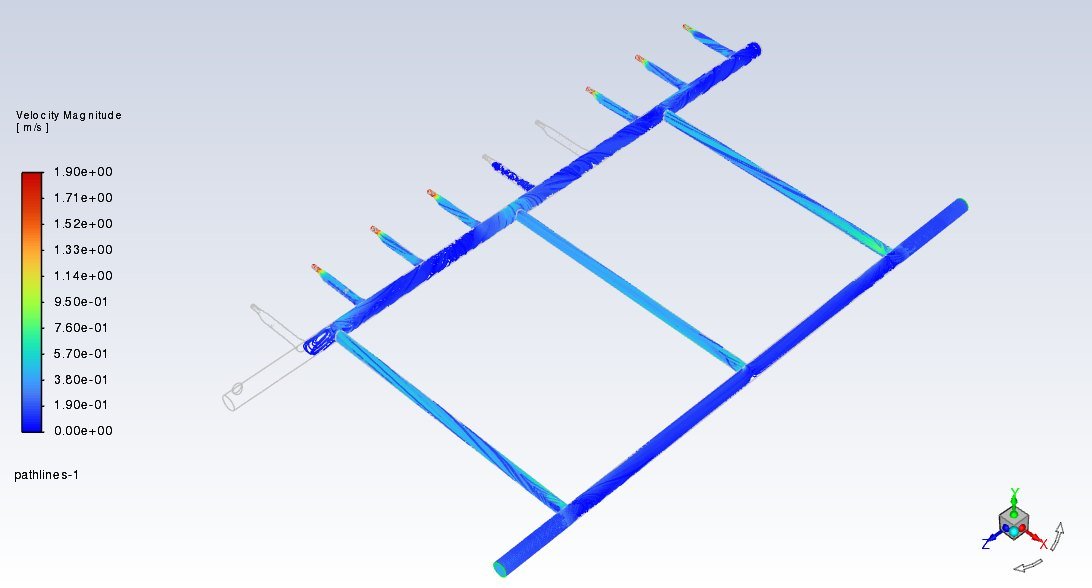
- With six duty pumps, each branch takes 16.53–16.80% of the flow against 16.67% for an even split, a maximum departure of 0.8%.
- With five pumps in service, the maximum departure is 0.85%, so the uniformity does not depend on a symmetric duty.
- The branches are small compared with the header, so branch resistance, not position along the header, governs the split.
- Results are mesh-independent: shares change by less than 0.08 percentage points across three meshes.
- Branch velocities of 1.32–1.67 m/s are within suction limits. No change to the manifold is needed. Stagnant standby legs should be covered in the operating philosophy for water age.
Working on a similar project?
Share your drawings, flows and design questions and we will advise on the right CFD scope.